
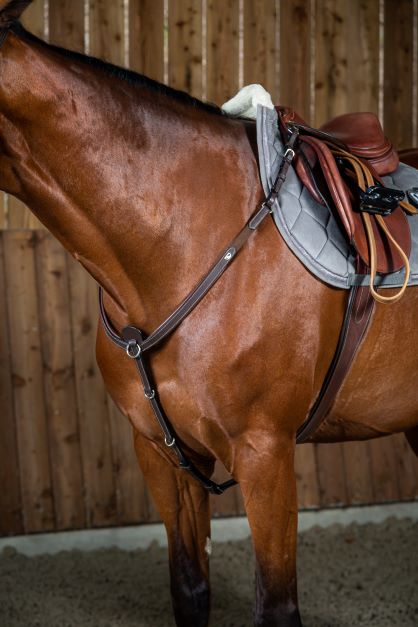
Fit, Attach and Maintain for Everyday Performance
TL;DR: This guide shows how to fit, attach and care for the Dy’on Working Collection Breastplate so it protects saddle position while keeping your horse comfortable for everyday riding, jumping and cross-country. We cover measuring for size, step-by-step fitting, adjusting the elastic shoulder inserts and long-term leather care.
- Measure chest width and distance to the saddle D-ring to choose Pony, Cob or Full.
- Attach the 3-point breastplate to the saddle and girth with a two-finger clearance and use the 6cm elastic inserts to preserve shoulder freedom.
- Clean with a mild leather cleaner and condition regularly; avoid over-oiling to protect the Grade 1 Buffalo leather.
After reading this guide you will be able to select the correct size Dy’on Working Collection Breastplate, fit it to an English saddle without restricting your horse’s shoulder, and maintain the leather so it stays functional and attractive. We walk through practical, numbered steps for putting the breastplate on a horse, explain how it works to stabilise the saddle, and outline the small adjustments that make it suitable for jumping, hacking or cross-country. Where technical terms are needed, we explain them in plain language so you can apply the steps with confidence.
What You Need
Prepare the following before you begin: your English saddle and girth, a soft measuring tape, the Dy’on Working Collection Breastplate in the selected size (Pony, Cob or Full), a clean sponge and towel, and approved leather cleaner and conditioner. Having a helper makes fitting faster and safer, especially when adjusting straps at the saddle.
Fit the Breastplate Correctly
-
Choose the Right Size
Start by selecting Pony, Cob or Full based on your horse’s chest width and overall build. Measure the widest part of the horse’s chest across the breastbone and note the distance from the centre of the chest up to where the breastplate’s centre strap would meet the saddle D-ring (roughly the front of the saddle flap). The Dy’on Working Collection is offered in three sizes to suit a broad range of equine shapes; choose the size that leaves room for adjustment rather than one that sits tight. If the tape measure suggests a borderline size, opt for the larger size and tighten the buckles during fitting.
-
Understand How a Breastplate Works
A breastplate prevents the saddle from sliding backwards and keeps the saddle centred when your horse extends or lands. The Dy’on is a 3-point design: two straps run up to the saddle’s D-rings and a central strap connects to the girth. This configuration stabilises the saddle without encircling the shoulders, and with the included 6cm elastic shoulder inserts the Dy’on allows movement while absorbing short, sharp pulls. Unlike a 5-point breastplate, which has extra lateral straps for maximal stability, a 3-point is simpler and gives the shoulder greater freedom — making it more suitable for jumping and cross-country where forward reach is essential.
-
Placing the Breastplate on the Horse
With the saddle already in place, lift the breastplate over the horse’s head so the chest piece sits on the breastbone with the shoulder straps running up towards the saddle D-rings. The centre strap should pass between the front legs to the girth. This is the practical answer to “How do you put on a breastplate?” and “How to put on a breastplate horse?” — position the breastplate before clipping to the saddle to avoid pinching and to check alignment.
-
Attach to the Saddle and Girth
Clip or buckle the two upper straps to the saddle’s D-rings and attach the centre strap to the girth using its buckle or snap. Adjust each buckle so that you can slide two fingers under the leather at the shoulder straps and the chest piece rests lightly on the breastbone. To attach the Dy’on Working Collection Breastplate to an English saddle and girth without restricting shoulder movement, use the elastic shoulder inserts to allow forward and lateral stretch; ensure the straps sit just above the point where the shoulder moves, not directly over it. If your saddle has D-rings set unusually forward or back, alter the strap lengths so the breastplate does not pull the saddle forward or press into the shoulder.
-
Fine-Tune for Comfort and Function
Once clipped, walk the horse and check the breastplate in motion. The elastic inserts should extend subtly as the forelimb moves; there should always be enough slack for natural shoulder rotation. For horses with wide chests or steep shoulder angles, the Dy’on offers multiple buckle adjustments to adapt to different chest widths and shoulder angles, but avoid forcing an extreme angle — in those cases, changing to Cob or Full size or using different strap hole positions is the safer option. Make small adjustments and re-check at the trot and canter to confirm the breastplate stabilises the saddle without chafing.
-
Attach Accessories if Needed
The Dy’on includes two additional D-rings for lunging gear and offers a removable martingale attachment. If you add a running martingale, attach it to the breastplate’s dedicated point and to the bit rings, then re-check range of motion. When using for jumping or cross-country, ensure the martingale and any attachments do not shorten the breastplate so much that shoulder movement is hindered. The Dy’on design allows easy customization while maintaining its core stabilising function.
Pro Tips for Best Results
First, always fit the breastplate with the saddle and girth adjusted to your usual riding setup; an unbuckled girth will give misleading clearances. Second, use the elastic areas to fine-tune dynamic comfort: if the elastic sits flat and never stretches in motion it may be too tight, while excessive sag indicates it is too loose. Third, if your horse will do both flat work and jumping, check the fit in both contexts — a setting that works for hacking may be restrictive during a jump if you forget to account for extension. Finally, when measuring for size, record both chest width and the distance to the saddle D-ring; keeping those measurements lets us quickly recommend Pony, Cob or Full for future purchases.
Common Mistakes to Avoid
One common error is fitting the breastplate too tightly across the shoulders; fix this by loosening the shoulder straps until you can comfortably slide two fingers under the leather and verify the elastic stretches in motion. Another mistake is attaching the centre strap too far forward on the girth — it should sit centrally and not pull the saddle up at the front. Lastly, over-conditioning the Grade 1 Buffalo leather can soften and darken it excessively; use leather conditioner sparingly and follow with a light buff rather than saturating the leather.
What Owners Are Saying
Owners consistently note the Dy’on’s clean, elegant look in buffalo leather and appreciate the ability to remove or add the running martingale attachment. Riders report the breastplate feels sturdy without heavy bulk, and that the additional D-rings are useful for lunging or temporary attachments during training. Several reviews highlight the practical balance between everyday durability and an appearance that suits competition, while others praise the elastic shoulder inserts for reducing restriction when the horse is at full stretch.
Secure Comfort And Function
Fitting the Dy’on Working Collection Breastplate correctly gives a measurable benefit: improved saddle stability with minimal impact on shoulder freedom. By measuring carefully for Pony, Cob or Full, using the 6cm elastic inserts to preserve motion, and following a simple cleaning routine you can keep the breastplate performing well across hacking, jumping and cross-country. If you follow the steps above you will have a reliable, comfortable setup that supports both everyday work and competition.